


508 Accessibility Compliance deadline Is Approaching
The U.S. Department of Justice (DOJ) has issued a final rule under Title II of the Americans with Disabilities Act (ADA) that establishes clear, enforceable requirements for digital accessibility. This rule confirms that websites and mobile applications operated by state and local governments must be accessible to people with disabilities.
A key update to the rule that was finalized in April 2024, changes the compliance deadlines to 2027 and 2028, depending on population size. It applies to nearly all digital services offered by public entities, including websites, online documents, videos, and mobile apps.
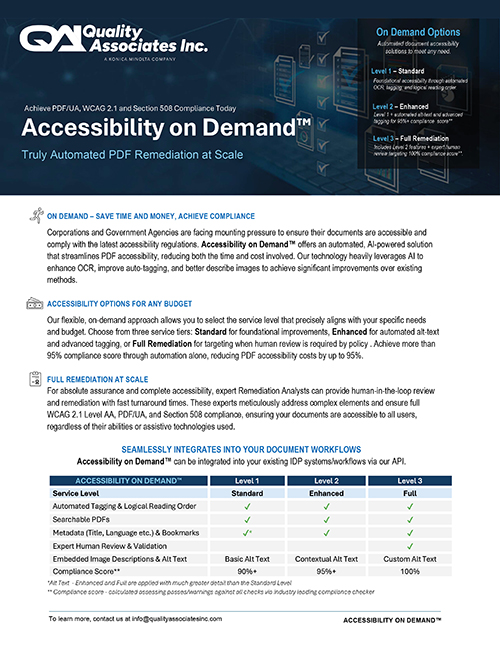
QAI helps organizations modernize legacy content with scalable remediation services. Our delivery model utilizes AI-powered automation, a tiered approach, and US based human-in-the-loop quality control.
WEBINAR:
AI-Powered Section 508 PDF Remediation: Fast, Scalable Results You Can Trust
508 Compliance Deadlines: April 26, 2027 and April 26, 2028
Countdown to the first deadline of April 26, 2027
The DOJ rule establishes two compliance dates based on population size:
- April 26, 2027 – Governments serving 50,000 or more people
- April 26, 2028 – Governments serving fewer than 50,000 people and special district entities
These deadlines apply regardless of when a website or mobile app was created. Existing content must be reviewed and updated as needed to meet accessibility standards.
Who Must Comply
The requirements apply to all local, state and federal government entities, including but not limited to:
- Cities, counties, state and federal agencies
- School districts and public universities
- Courts and election offices
- Public libraries, parks, and recreation departments
- Transit authorities and special districts
If an organization qualifies as a public entity under ADA Title II, its digital content is covered—regardless of whether services are delivered directly or through third‑party vendors.
Why This Matters
Accessible digital services allow all residents to participate fully in civic life. Inaccessible websites can prevent individuals with disabilities from accessing essential services such as voting information, permits, benefits, educational resources, and public meetings.
Beyond legal compliance, improving accessibility supports inclusion, transparency, and public trust—while also reducing the risk of complaints, enforcement actions, or litigation.
Digital Transformation Initiatives: WHAT WE DELIVER
Automation-First Accessibility
AI-powered OCR, auto-tagging, logical reading order, metadata, bookmarks, and image descriptions to accelerate
document accessibility at scale.
Expert Remediation & Validation
Specialists review complex layouts, tables, charts, forms, and high-visibility content when policy, legal risk, or publishing standards require higher assurance.
Workflow Integration
Flexible support for centralized accessibility programs, shared services, and API-enabled or batch-processing models aligned to enterprise document workflows.
QAI’s Accessibility on Demand™ (AOD)
- High‑volume PDF and digital content remediation
- WCAG 2.1 AA and PDF/UA compliance
- Predictable pricing for Procurement
- Workflow alignment for Records and IG teams
- Immediate capacity relief for IT and ADA coordinators
As compliance deadlines approach, AOD helps agencies reduce risk, control costs, and modernize accessibility without slowing operations.
Getting Started
Public entities should begin preparation by:
- Auditing websites and digital content for accessibility issues
- Identifying high‑priority services and documents
- Remediating barriers to meet WCAG 2.1 AA standards
- Establishing ongoing processes to maintain accessibility
.
Compliance Resources

Navigating Section 508 and FOIA Compliance: A Checklist for Government Agencies

How FADGI-Compliant Digitization Improves Government Work
